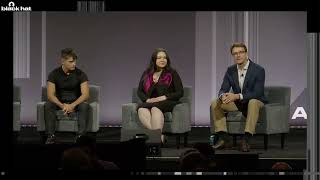
Anatomy of a Takedown: Inside the Operation That Broke LockBit
Brett Leatherman, Paul FosterBlack Hat USA 2026
Chris Butera is the Acting Executive Assistant Director for the Cybersecurity Division of the Cybersecurity and Infrastructure Security Agency (CISA). As CISA’s senior career cybersecurity official, he is responsible for leading the agency’s mission to address the nation’s most significant cyber threats and vulnerabilities and to increase the security and resilience of U.S. critical infrastructure. Mr. Butera additionally serves as a board member for both the Technology Modernization Fund and the Federal Risk and Authorization Management Program (FedRAMP). Mr. Butera brings a wealth of experience to his role with over 20 years in various cybersecurity and Information Technology (IT) leadership positions in federal and local government as well as the private sector. Most recently, he served as the Senior Technical Director for the Cybersecurity Division of CISA. In that role, Mr. Butera led the Office of the Technical Director, which magnifies the impact of CISA’s cyber mission by enhancing cyber services and analysis platforms, strengthening operational visibility, guiding cyber research and development, and leading strategic work in securing Artificial Intelligence and Industrial Control Systems (ICS)/Operational Technology (OT). Throughout his federal career, Mr. Butera has led much of CISA’s cyber defense operations, including the federal government’s response to the most significant cybersecurity incidents facing the United States between 2014 through 2021. Previous leadership roles at CISA include Associate Director of Threat Hunting, Deputy Director of the National Cybersecurity and Communications Integration Center (NCCIC), and Chief of the NCCIC Hunt and Incident Response Team. Mr. Butera’s interests lie in emerging technologies, software security, international standards, new techniques for threat detection, and developing hands-on learning opportunities such as CTFs. Mr. Butera holds a Bachelor of Science degree in computer science from the University of Notre Dame and a Master of Science degree in computer science from the University of Chicago.
Robert (Bob) Costello is the Chief Information Officer (CIO) at the Cybersecurity and Infrastructure Security Agency (CISA). As the CIO, he leads the Agency’s efforts to develop, deploy, secure, and support technology solutions for the agency. Prior to this, he was a Public Sector Civilian Strategic Advisor at World Wide Technology. In this role, he engaged with federal government customers to identify and solve their most complex challenges, leveraging his extensive federal agency experience to develop and deliver innovative solutions that meet their needs and serve their mission.Bob brings a wealth of experience serving over 13 years at DHS, both at Immigration and Customs Enforcement and Customs and Border Protection. He also served as the Senior Executive Service as the Executive Director (XD) of the Office of Information and Technology (OIT) Enterprise Networks and Technology Support Directorate (ENTSD) at CBP, as well as serving concurrently in the role of Acting XD of the Border Enforcement and Management Systems Directorate. During his tenure in ENTSD, he oversaw the modernization of the largest data network in DHS, improved connectivity to cloud service providers, and dramatically increased the agency’s usage of mobility platforms. He also oversaw the agency’s movement to the TIC 3.0 framework and implemented zero trust solutions at the network level. He led the operations of the agency’s land mobile radio network, the National Law Enforcement Communications Center, and maintenance of the non-intrusive inspection systems utilized at all ports of entry. He also directed all software development for the U.S. Border Patrol, and all of the agency’s mission support systems, moving over 100 applications to a SECDEVOPS development methodology. Earlier in his career, Costello served as the Deputy Executive Director (DXD) and acting XD for OIT’s Field Support Directorate (FSD) supporting information technology, radio systems, and enforcement technologies worldwide, as well as worked at ICE as the Director of Network Engineering overseeing networks worldwide and implementing solutions for mobility and datacenter migrations, e-discovery, and collaboration solutions. Costello is a nine-year veteran of the U.S Air Force and U.S. Air Force Reserves. He holds a Bachelor of Arts degree in Organizational Leadership from Fordham University and is a Certified Information Systems Security Professional and Project Management Professional.
Frank J. Cilluffo is the Director of the McCrary Institute for Cyber and Critical Infrastructure Security at Auburn University and host of the weekly Cyber Focus podcast. Cilluffo was a member of the U.S. Cyberspace Solarium Commission and served on the Department of Homeland Security's Advisory Council where he chaired various initiatives on counterterrorism, cybersecurity and economic security. He's routinely called upon to advise senior officials in the executive branch, U.S. Armed Services, and state and local governments on an array of matters related to national, homeland, and cyber security strategy and policy. He has publicly testified before Congress on dozens of occasions, serving as a subject matter expert on policies related to cyber threats, critical infrastructure security, counterterrorism, weapons proliferation, intelligence and threat assessments, emergency management, and border and transportation security. Immediately following the Sept. 11, 2001 terrorist attacks, Cilluffo served as a Special Assistant to President George W. Bush in the newly created White House Office of Homeland Security. There, he was involved in a wide range of homeland security and counterterrorism strategies, policy initiatives and served as a principal advisor to Governor Tom Ridge and directed the President's Homeland Security Advisory Council. Cilluffo then joined George Washington University in 2003, establishing the Center for Cyber and Homeland Security as a prominent nonpartisan "think and do tank" dedicated to building bridges between theory and practice to advance U.S. security. He served as an associate vice president at GW where he led a number of national security and cybersecurity policy and research initiatives. He directed the Center for Cyber and Homeland Security and, with the School of Business, launched the university's World Executive MBA in Cybersecurity program. Prior to his White House appointment, Cilluffo spent eight years in senior policy positions with the Center for Strategic and International Studies, a Washington-based think tank. There, he directed numerous committees and task forces on homeland defense, counterterrorism and transnational organized crime, as well as information warfare and information assurance. He has published extensively in academic, law, business and policy journals, as well as magazines and newspapers worldwide. His work has been published through ABC News, Foreign Affairs, Foreign Policy, Fox News, The Journal of International Security Affairs, The National Interest, Newsweek, Parameters, Politico, Studies in Conflict and Terrorism, USA Today, U.S. News & World Report, The Washington Quarterly, The Wall Street Journal, and The Washington Post. He previously served as an on-air consultant for CBS News and currently serves as a Trustee for the Alabama School of Cyber Technology and Engineering and is Chairman of the Advisory Board of Cyber Florida.
Despite talk of its decline, the US Cybersecurity and Infrastructure Security Agency says it's still hard at work. CISA's Chris Butera and Bob Costello join Frank Cilluffo of Auburn University's McCrary Institute to talk about how the agency treats cybersecurity as national security. They describe how CISA works with the companies that run critical infrastructure, on the threats of today and on new technology as it arrives. Worth an hour if you work in or alongside US critical infrastructure.
Did you find what you came for?
Thanks, that helps us improve this page.